Hello, and welcome to Claire's/Ember's first post on the Pattern and Find blog! (For more on Ember check out our first post and also read Tales from Earthsea by Ursula K. LeGuin!)
Mr. Kettenburg, my highschool U.S. History and Economics teacher, taught me to begin my essays with a map. This not only helped readers, but helped me, the writer, too. To know where we're going, and when. The nifty thing about digital documents, is you can also use a map to jump around to the places you're interested in going. Please feel free to come along with me on the narrative journey, or just navigate to the sections that interest you! In this blog post we will travel to the following places:
Why please + flourish?
When we first came up with the name, pattern and find, we started to think of all sorts of other combinations of words that started with p and f that seemed to meld together quite nicely! These are too much fun to give up, and so the plan is to title each general blog post with one of these p and f combinations.
Today, as I was journaling about pattern and find-- the kind of space I want it to be, the kinds of things I want to grow here-- the words 'please' and 'flourish' came to me.
Please because I am learning to ask myself nicely to spend time on the things that nurture me, give me sunlight and song. Many things within me are now seeds, just like pattern + find, but I hope someday they will be a garden, a grove, an orchard, a forest.
Please, I am learning to say to myself, after reading The Artist's Way, and realizing how true it is that the part of me who who creates and imagines needs to be treated with immense kindness and with sweet words. Please, Claire, I say to myself, spend time in this secret soil, see what's living, and help it thrive!
welcome to the secret garden

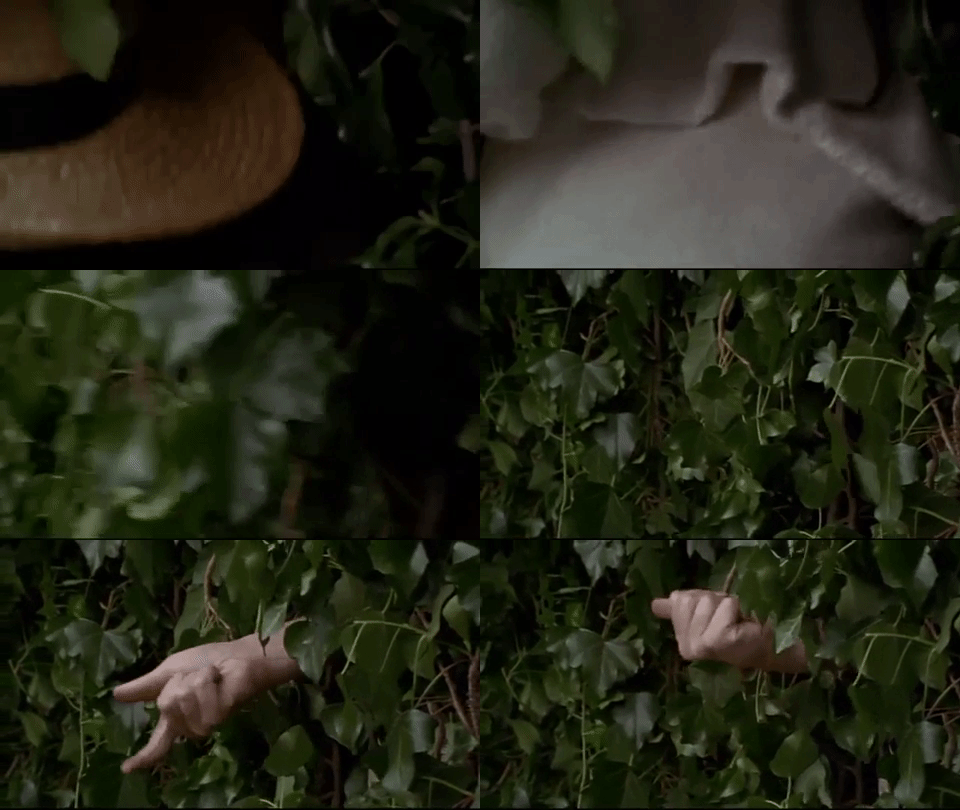
Please also because I find it pleasing to work on this, in this space. It pleases me, and I want it to please others as well. To be aesthetically pleasing in its design, and pleasing in its content. To bring joy, and healing, and much needed shade to hot places, water to dry ones, etc.
And flourish? Flourish-- because I am already overwhelmed, in this very paragraph, by how much there is that I want to do here, to grow, to plant. To tend to, and be responsible for.
Letting it be alright, even, wonderful, that there's place for all that to flourish. Not just grow, but really grow-- to jurassic park, mammoth, land-before-time sizes, to invite diverse forms and content, to let it be over-the-top, and teeming with life, and everything-just-so, and also, to be functional and fun.
Alright, so that's a lot of metaphors, you might be thinking! What's this whole 'pattern + find' project really about? What's the point? And why the blog?
Well why don't we open this ivy covered door, and walk together down this growing path. I'll tell you all I know about this place so far, which is some. But I also have so much to learn...
Picking up the work of decolonization
I was recently reading Xwi7xwa Library's excellent Research Guide on Decolonization and Anti-racism, and was greatly impacted by this video they shared.
Entitled 'Decolonization Is for Everyone', Nikki Sanchez shares how important it is for all of us to do decolonial, reflective work. If you have the time, I strongly recommending pausing your read-through of this blog post, and going to watch the video right now! And while you're there, check out some of the other amazing resources too!
If, for whatever reason, you're not in a place to watch the video right now, definitely bookmark it for later.
What follows draws heavily on her work, and I encourage you to listen to the talk itself, in addition to reading my reflections on it below.
Sanchez begins by asking the audience if they can name the territory and the nation on whose lands their grandmothers were born. I know that my maternal grandmother, Grandma E., was born in Scotland, the Indigenous lands of the Picts and the Gaels. My paternal grandmother, Grandma S.? I have no idea. I think she was born in what's now known as New York City, which a quick search at Native-land.ca tells me may be the ancestral territories of the Wappinger peoples.
But there is an erasure there, an amnesia, that I hope the practices we are taking up in this project will help me to unlearn, to remember.
Sanchez goes on to discuss the pain this question elicits, the inter-generational trauma which had to occur for settlers to be complicit in genocide. This trauma, which Sanchez calls historical bystander trauma, is carried forward to the present day. And is perpetuated, as in my own lifetime I have and continue to witness ongoing forms of genocide, of state-sanctioned violence. But just because this history is traumatic, does not mean we can look away.
"In order for us to know where we want to go together, we need to know where we are, and for us to know that, we need to know where we've been." (Sanchez, 2019)
This sentence, in a nutshell, is what turned me onto libraries and archives. I wanted to work with the past to help inform the future.
But, over the past few years, and since I've gained more experience as a practicing archivist, and also learned from amazing teachers such as Amy Perreault, Sarah Dupont, and Jennifer Douglas, I have begun to realize that I also must work with my past to help inform my future. And this is what is at the heart of pattern + find, for me. A place to uncover, to recover my past, with my eyes on the prize of a new kind of future.
Sanchez goes onto to unpack the history of colonization in Canada, and in particular the history of Indian Residential Schools. Please do go watch this video, as it's an incredibly succinct and clear summary of colonization in the Canadian context. She also shares what colonization looks like today in Canada: the occupation of Indigenous territories, the over 4,000 missing and murdered Indigenous women, ongoing resource extraction and poisoning of Indigenous lands and waters.
"I work with a lot of settler people who want to do something about this, but they don't know where to begin. And they feel paralyzed with guilt and shame about this truly ugly history that we've all found ourselves in. And so, if I could just leave you with one message today it would be this: This history is not your fault. But it absolutely is your responsibility." (Sanchez, 2019)
I write this today as a daughter, a granddaughter, a great-granddaughter, a great-great-granddaughter of settlers. As a settler, an uninvited person living on unceded, stolen, and occupied lands of the Musqueam, Squamish, and Tsleil-Waututh peoples. As a white person. As a cis-gendered woman. As someone who has professional training in libraries and archives, both themselves systems that have played a central role in maintaining oppressive, imperial, colonial control. I am writing this as a native english speaker, someone who grew up trained in the syntax, grammar, and ontologies of the language of colonizers. As a white, settler, cis-gendered english-speaking woman working as an archivist, I am writing this from a place of privilege. This privilege, and the knowledge of the historical and ongoing systems that work to maintain this privilege at the cost of so much LIFE, has, often, left me paralyzed with shame and guilt. At times, it has left me contemplating suicide as the best solution I could personally take to 'solve', absolve, resolve these legacies.
But Sanchez's video reminds me what I know inherently to be true. That I do have gifts to give, that I do have work to do, work in community, in collaboration, alongside others. That I have a light to shine, a path to walk. My gifts and passions include story-telling, design, poetry, archives and libraries, analogue culture, digital tools, low-tech and highly pleasing spaces of access to stories, inheritances, games, adventures, and learnings.
"It takes courage to heal" I remember the super-talented somatic therapist, Fayza Bundalli, said to me, and I felt that truth in my body, being scared to heal. And I repeated it to the incredible body-worker, Tracey Dixon, and she replied, "Yes. Because when you heal, everything changes". I was seeking healing with the help of both of these people, and their wise words stayed with me.
I believe that like therapy, like body-work, historical work, remembering is a form of healing. And it does take courage, a courage which Sanchez astutely points out, "We need to have the courage to look at our past, we need to have the courage to look at where we are now and we need to work together to figure out how we can collectively heal moving forward." (Sanchez 2019)
screenshots from Nikki Sanchez's excellent ted talk
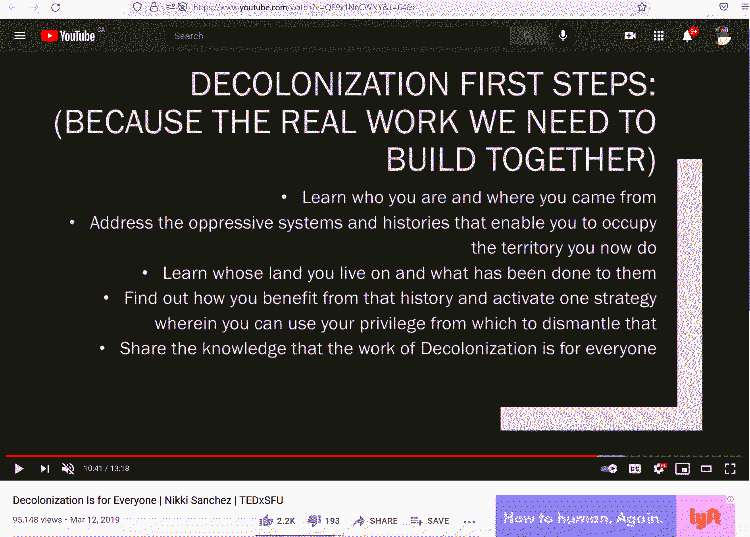
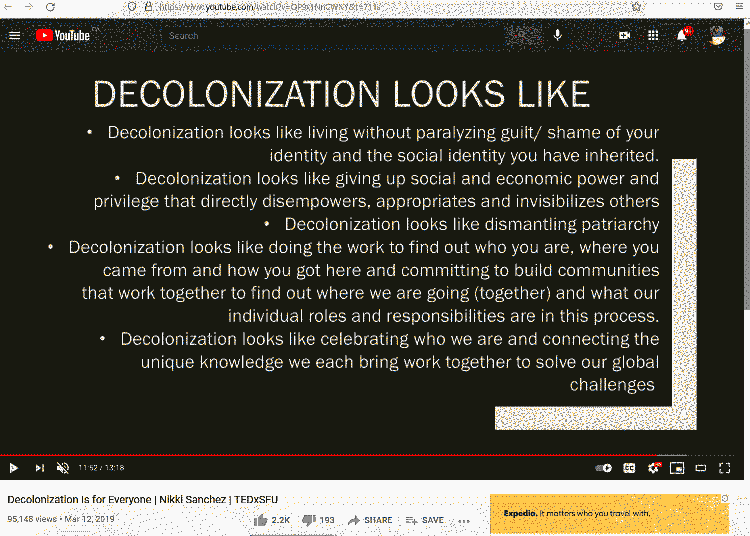
A note on these screenshots. 1) They are dithered using a web-app called DitherIt. 2) Look at the down votes! They remind me how much this work is needed. 3)And look at the weirdly on-point advertisements. Very indicative of the greyish post-covid world we're about to be living in. From Lyft, 'How to human. Again' 'How to human, again', is really the work of decolonization. And from 'Expedia' we have, 'It matters who you travel with.' Yes. Yes, it does Expedia. And decolonization is work that needs to be done, so we can travel together. And get rid of corporations like yours along the way! <3 <3 <3
I'm including these screenshots, because to me they are centric to the work I want to undertake through pattern + find. Work of understanding who I am and where I came from. Work to address the oppressive systems and histories that enable me to occupy the territory I am on. To learn more about this land and the history of the peoples who have lived here since time immemorial. To find out how I benefit from that history, and activate (at least!) one strategy wherein I can use my privilege from which to dismantle its continuation. Sanchez asks the audience to "Share this knowledge [that decolonization is for everyone], with your barista, with you babysitter, with your tinder date. I don't care."(Sanchez 2019) So-- we're sharing our processes in pattern + find with you all. The whole internet!
"What can I do to decolonize? Well it's not going to be a one answer, it's not going to be a one-day fix. However I can give you a few first steps, because if you do your work than we can come back together and collectively do the real work that needs to be done." (Sanchez 2019)
pattern + find is, put simply, a place. A digital place that K and I are building together, but in a sense, it is a place that has already existed. A place to do this work together. Much like the sacred grove in Earthsea. A place we go to for healings, answers, adventures, love, magic. A slightly dangerous place one could get lost in if one isn't careful!
I am asking myself to please continue doing this work, coming to this place, and to let it flourish. I am asking you to please join us, if you so wish, to flourish in kind.
Too long, didn't read
Check out this quote from Nikki Sanchez's TedxSFU Ted talk (and when you have time watch the video.)
"Decolonization looks like doing the work to find out who you are, where you came from, and committing to build communities that work together to collectively create a more sustainable and just future. And finally, decolonization looks like celebrating who we are and connecting with the unique knowledge that we each bring to this time and that we need to solve the problems that are laid out in front of us." (Sanchez 2019)
Through pattern + find we are hoping to do decolonial, healing work through genealogical research and transparent personal record-keeping. To remember, and from that place of memory, ask how we can work in community to collectively create new futures. To celebrate and share the unique gifts we have, and to apply them to the problems in front of us.
Works Cited
Sanchez, Nikki. (2019, March 12). Decolonization is for everyone [Video]. YouTube. https://www.youtube.com/watch?v=QP9x1NnCWNY